
Logistics companies today are under constant pressure to deliver faster, reduce operational costs, and maintain complete visibility across increasingly complex supply chains. As a result, many businesses are evaluating SaaS application development for logistics companies as a way to modernize operations without investing heavily in infrastructure.
However, in real-world logistics environments, technology decisions are rarely as simple as choosing a SaaS platform. The right approach depends on how a business operates today, what systems it already uses, and how complex its workflows are.
In many cases, cloud-based logistics platforms provide the flexibility and scalability businesses need. In other situations, they may not fully address specialized requirements. This is why companies need to evaluate their operational needs before selecting a technology approach.
Why Cloud-Based Platforms Are Becoming Important in Logistics?
Modern logistics operations involve multiple moving parts, including transportation networks, warehouse activities, inventory management, supplier coordination, and customer communication. Managing these processes through disconnected systems can create visibility gaps and slow down decision-making.
Cloud-based logistics platforms help businesses centralize operational data and provide access to information across teams, locations, and partners. Unlike traditional systems that may require significant infrastructure investment, these platforms allow companies to adopt digital capabilities with greater flexibility.
Scalability is another reason businesses consider SaaS solutions. As logistics operations expand, cloud platforms can support additional users, locations, and workflows without requiring major changes to the underlying infrastructure.
For companies looking to improve collaboration and operational efficiency, SaaS-based applications can provide a practical foundation for digital transformation.
Where SaaS Application Development Fits Well in Logistics?
SaaS applications are particularly effective when logistics operations follow structured and repeatable workflows.
For example, businesses managing shipment tracking, warehouse coordination, order processing, or multi-location inventory can benefit from centralized cloud applications. These systems allow teams to access updated information in real time, helping reduce communication gaps between suppliers, transporters, warehouses, and customers.
SaaS platforms are also useful for businesses that want faster deployment. Instead of spending significant time building and maintaining infrastructure, organizations can focus on improving their processes and customer experience.
However, the effectiveness of a SaaS solution depends on how closely it matches the company’s operational requirements.
Where SaaS May Not Be Enough for Logistics Businesses?
While SaaS platforms provide several advantages, they are not designed to solve every logistics challenge.
Some logistics companies operate with highly specific workflows, complex approval processes, or specialized compliance requirements. In these cases, a standard SaaS platform may require additional customization or integration to support unique business needs.
Integration is another important factor. Logistics organizations often use multiple systems, including ERP platforms, warehouse management systems, fleet tracking solutions, and customer portals. If these systems require complex data exchange, businesses need to carefully evaluate whether the chosen platform can support the required integrations.
In certain situations, companies may need additional custom components alongside SaaS platforms to achieve the required level of flexibility and control.
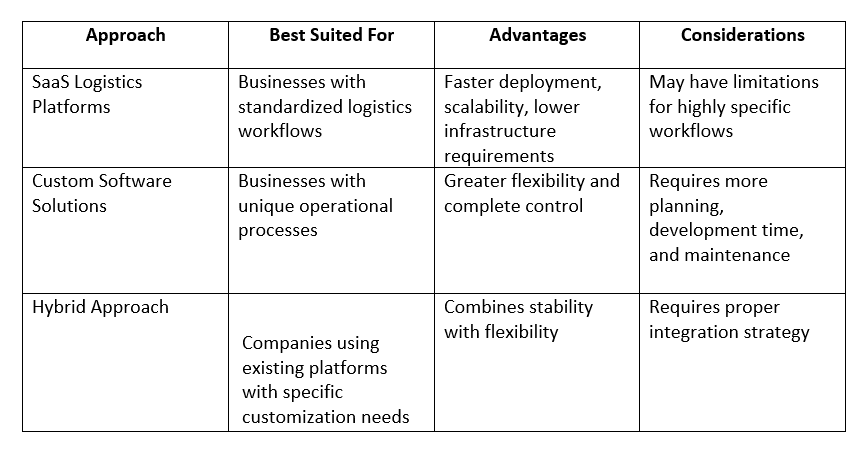
SaaS vs. Custom Solutions vs. Hybrid Approach
The right technology decision is not always about choosing between SaaS and custom development. Many successful logistics businesses combine different approaches based on their operational requirements.
How AI Capabilities Are Enhancing Logistics Applications?
Artificial intelligence is becoming an important capability within modern logistics technology. While SaaS platforms provide the foundation for managing operations, AI helps businesses make smarter decisions using real-time and historical data.
AI-powered logistics applications can support areas such as demand forecasting, route optimization, delivery prediction, inventory planning, and operational analytics.
For example, AI algorithms can analyze shipment patterns and historical data to identify potential delays before they impact customers. Similarly, predictive analytics can help businesses understand demand trends and optimize inventory levels.
When combined with cloud-based logistics platforms, AI capabilities enable companies to move beyond basic process management and achieve more intelligent, data-driven operations.
However, AI implementation should also be based on actual business requirements. Not every organization needs advanced AI capabilities immediately, and businesses should evaluate where AI can deliver measurable operational improvements.
Choosing the Right Technology Strategy for Logistics Operations
The most effective logistics systems are those that align with actual business processes rather than forcing companies to adjust their operations around software limitations.
Before investing in SaaS application development, businesses should evaluate their current systems, workflow complexity, integration requirements, and future growth plans.
For some companies, a SaaS platform may provide everything required to improve efficiency. For others, additional integrations, custom modules, or AI-powered enhancements may be necessary.
The goal should always be selecting a technology approach that supports business objectives while maintaining flexibility for future growth.
A Balanced Technology Approach from SmallDay Tech
At SmallDay Tech, the focus is on understanding business challenges before recommending a technology solution. The objective is not to promote SaaS, custom software, or any single approach as the default choice.
Depending on business requirements, the right solution may involve implementing a SaaS platform, integrating existing systems, adding AI capabilities, or developing targeted enhancements for specific operational needs.
By evaluating the complete technology landscape, businesses can create logistics systems that improve visibility, efficiency, and long-term scalability.
Conclusion
SaaS application development for logistics companies has become an important part of digital transformation, offering businesses greater flexibility, accessibility, and scalability.
However, SaaS is not a universal solution for every logistics operation. The right approach depends on workflow complexity, integration requirements, data needs, and long-term business goals.
Companies that make informed technology decisions, whether through SaaS platforms, custom enhancements, or hybrid models, are better positioned to build efficient and adaptable logistics operations.
FAQs
What is SaaS application development for logistics companies?
SaaS application development for logistics companies involves creating cloud-based software solutions that help manage logistics operations such as transportation, inventory, warehouse activities, and supply chain coordination.
Why are logistics companies adopting SaaS platforms?
Logistics companies adopt SaaS platforms because they provide scalability, real-time accessibility, faster deployment, and reduced infrastructure requirements.
Is SaaS suitable for every logistics business?
No. SaaS works well for many standardized operations, but businesses with complex workflows or specialized requirements may need additional customization or hybrid solutions.
How does AI improve logistics applications?
AI helps logistics companies improve forecasting, optimize routes, predict delays, automate processes, and gain better insights from operational data.
Can SaaS platforms integrate with existing logistics systems?
Yes. SaaS platforms can integrate with ERP systems, warehouse management solutions, fleet tracking tools, and other business applications depending on technical requirements.
Choosing the right logistics technology approach is not about following industry trends but understanding what works best for your operations. SaaS platforms can deliver significant value, but the right solution depends on your business model, existing systems, and future objectives.
SmallDay Tech helps logistics companies evaluate their technology requirements and identify practical solutions, whether that involves SaaS platforms, integrations, AI-powered capabilities, or targeted enhancements designed to improve operational efficiency and visibility .

