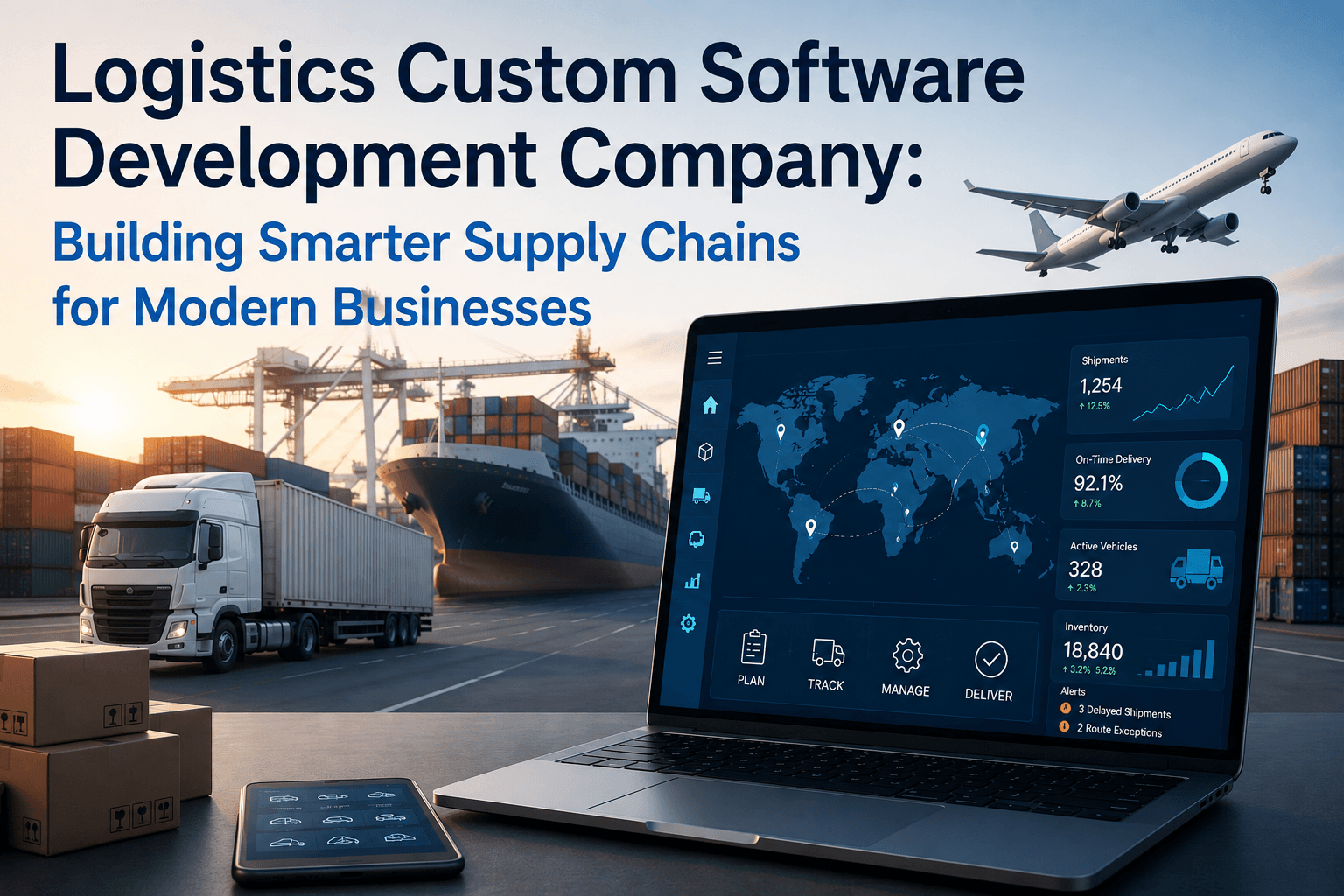
The logistics industry is evolving rapidly due to increasing global trade complexity, rising customer expectations, and the growing demand for real-time visibility across supply chains. Businesses today rely heavily on digital systems to manage transportation, warehousing, inventory, and last-mile delivery with greater accuracy and speed. In this environment, the term logistics custom software development company often comes up when organizations explore ways to modernize operations. However, the right solution is not always custom-built software. In fact, many logistics companies already operate successfully using established platforms such as SAP Transportation Management, Oracle Transportation Management, CargoWise, and Project44, which are designed to handle most standard logistics requirements effectively.
The real challenge is not choosing between custom software and off-the-shelf systems, but understanding where each approach adds value. ## Understanding the Role of a Logistics Custom Software Development Company
A logistics custom software development company typically works on designing and building tailored software solutions for transportation, warehousing, fleet operations, inventory tracking, and supply chain coordination. However, in modern logistics ecosystems, this role has evolved beyond just building standalone systems.
Today, most businesses benefit from a hybrid technology approach where enterprise logistics platforms form the foundation, while custom software is developed only to address specific operational gaps, integration challenges, or unique business models. This ensures that companies do not reinvent what already exists, but instead enhance what they already use. **
Where Enterprise Logistics Platforms Work Best**
For a large number of logistics operations, enterprise-grade systems like SAP TM, Oracle TMS, and CargoWise already provide a strong and reliable foundation. These platforms are especially effective when businesses require standardized logistics capabilities such as shipment management, warehouse coordination, freight handling, regulatory compliance, and end-to-end visibility across supply chains.
Since these systems are mature and continuously updated, they reduce the need for building everything from scratch and allow organizations to adopt proven workflows that are widely used across the industry. ## When Custom Logistics Software Becomes Necessary
Even though enterprise systems are powerful, they do not always cover every unique operational requirement. This is where a logistics custom software development company becomes valuable.
Custom development is typically required when businesses face specific workflow gaps that cannot be efficiently resolved within existing platforms. In many cases, organizations already use a core system like SAP or Oracle but need additional modules to support highly specialized processes.
Another common scenario is when companies struggle with complex integrations across multiple systems such as ERP, CRM, warehouse platforms, and third-party logistics providers. If integration becomes too costly or technically restrictive within SaaS limitations, a targeted custom solution can provide a more efficient alternative.
In some industries, particularly cold chain logistics, fleet tracking, and high-value cargo monitoring, IoT devices and real-time sensor data play a critical role. Standard platforms may not fully support these specialized data flows, making custom systems necessary to process and analyze real-time information effectively.
There are also cases where enterprise systems become too complex for smaller or mid-sized logistics teams. In such situations, the learning curve, training overhead and operational complexity can reduce adoption. A simplified custom-built interface focused on essential workflows can significantly improve usability and efficiency.
Finally, cost considerations also influence decision-making. When logistics operations reach a very high transaction volume, SaaS pricing models based on shipments, users, or API usage can become expensive over time. In such cases, building a focused custom system can sometimes offer better long-term cost efficiency.
**## The Hybrid Approach to Logistics Technology ** Modern logistics companies are increasingly adopting a hybrid strategy instead of relying entirely on either custom software or off-the-shelf platforms.
In this approach, enterprise systems such as SAP TM, Oracle TMS, or CargoWise act as the core operational backbone, while custom-built components are added only where necessary. These may include workflow extensions, integration layers, analytics dashboards, or automation modules designed to handle specific business requirements.
This combination allows organizations to maintain stability through proven platforms while also gaining flexibility through tailored enhancements. It reduces operational risk while still enabling innovation where it matters most. **
How AI Is Transforming Logistics Operations**
Artificial intelligence is playing an increasingly important role in improving logistics efficiency and decision-making. Many modern systems now use AI to analyze historical and real-time data to improve forecasting, optimize delivery routes, and reduce operational delays.
AI-driven logistics systems can help predict shipment disruptions caused by traffic, weather conditions, or supply chain bottlenecks. They also assist in inventory forecasting, warehouse optimization, and automated dispatch planning. As a result, businesses can respond faster to changes while reducing manual effort and operational costs.
In more advanced cases, companies integrate AI capabilities on top of existing logistics platforms to extract deeper insights from their operational data.
## A Balanced Approach from SmallDay Tech
At SmallDay Tech, the focus is not on recommending custom development by default, but on identifying the most effective and practical technology approach for each business requirement.
In many cases, this means implementing enterprise logistics platforms and optimizing them for better performance. In other situations, it involves building custom modules to bridge specific gaps or developing integration layers that connect multiple systems into a unified ecosystem. AI-driven analytics and IoT-enabled logistics solutions are also explored when they align with business needs.
The goal is always to improve efficiency, visibility, and scalability without adding unnecessary complexity or cost.
## Conclusion
A logistics custom software development company plays an important role in modern supply chain transformation, but custom software is not always the starting point or the default solution. Many logistics businesses already achieve strong results using platforms like SAP TM, Oracle TMS, and CargoWise.
Custom development becomes relevant only when there are specific operational gaps, integration challenges, IoT requirements, or cost inefficiencies that cannot be addressed effectively through existing systems.
The most successful logistics companies today follow a balanced and strategic approach, combining the reliability of enterprise platforms with the flexibility of custom-built enhancements where truly needed.
## FAQs
What does a logistics custom software development company do? It designs and develops tailored software solutions or system extensions that enhance logistics operations and integrate with existing enterprise platforms.
Do logistics companies need custom software? Not always. Many companies rely effectively on enterprise solutions like SAP TM, Oracle TMS, and CargoWise. Custom software is used only when specific gaps or limitations exist.
When is custom logistics software a better option? It is typically considered when businesses face integration challenges, unique workflow requirements, IoT-based operations, or high SaaS cost inefficiencies.
Can custom logistics software work with existing systems? Yes. Custom solutions are often built to integrate seamlessly with ERP systems, TMS platforms, and other logistics tools.
How does AI improve logistics operations? AI helps improve forecasting, route optimization, demand prediction, automation, and overall decision-making by analyzing large volumes of operational data.
If you are evaluating logistics technology options, SmallDay Tech can help you identify whether your business needs a custom solution, an extension to an existing platform, or a fully integrated hybrid approach. Our team focuses on building scalable, cost-efficient logistics systems that improve visibility, reduce operational complexity, and support long-term growth.
Get in touch with us to discuss your logistics challenges and explore the right technology approach for your business.